SSA Disability Benefits Resource Kit
Supporting the application process for Social Security Administration (SSA) disability benefits.

Duration
Sep - Nov 2023
Location
Savannah, USA
My Responsibilities
Project Lead
Tools
Figma
Miro
Adobe Indesign
Project Timeline
The Clients
The Social Security Administration (SSA) manages critical federal safety nets, including the SSDI and SSI programs. Under intense operational strain, the agency's legacy intake processes directly impact application processing speeds and public service delivery.
Pain Points
Resource Constraints
The SSA faced significant budget cuts post-pandemic, hindering their ability to hire additional staff to alleviate the workload on existing SSA workers.
Knowledge Silos
SSA workers lack comprehensive knowledge to guide applicants effectively due to the complexity of various departments and frequent changes in rules.
Systemic Backlogs
The SSA's infrastructure is strained by a high volume of applicants, leading to long decision times and a backlog. This limits SSA workers' ability to provide personalized guidance.
Context
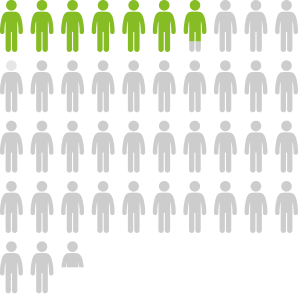
Only 7.8 million out of the 42.5 million disabled Americans received disability benefits as of June 2022
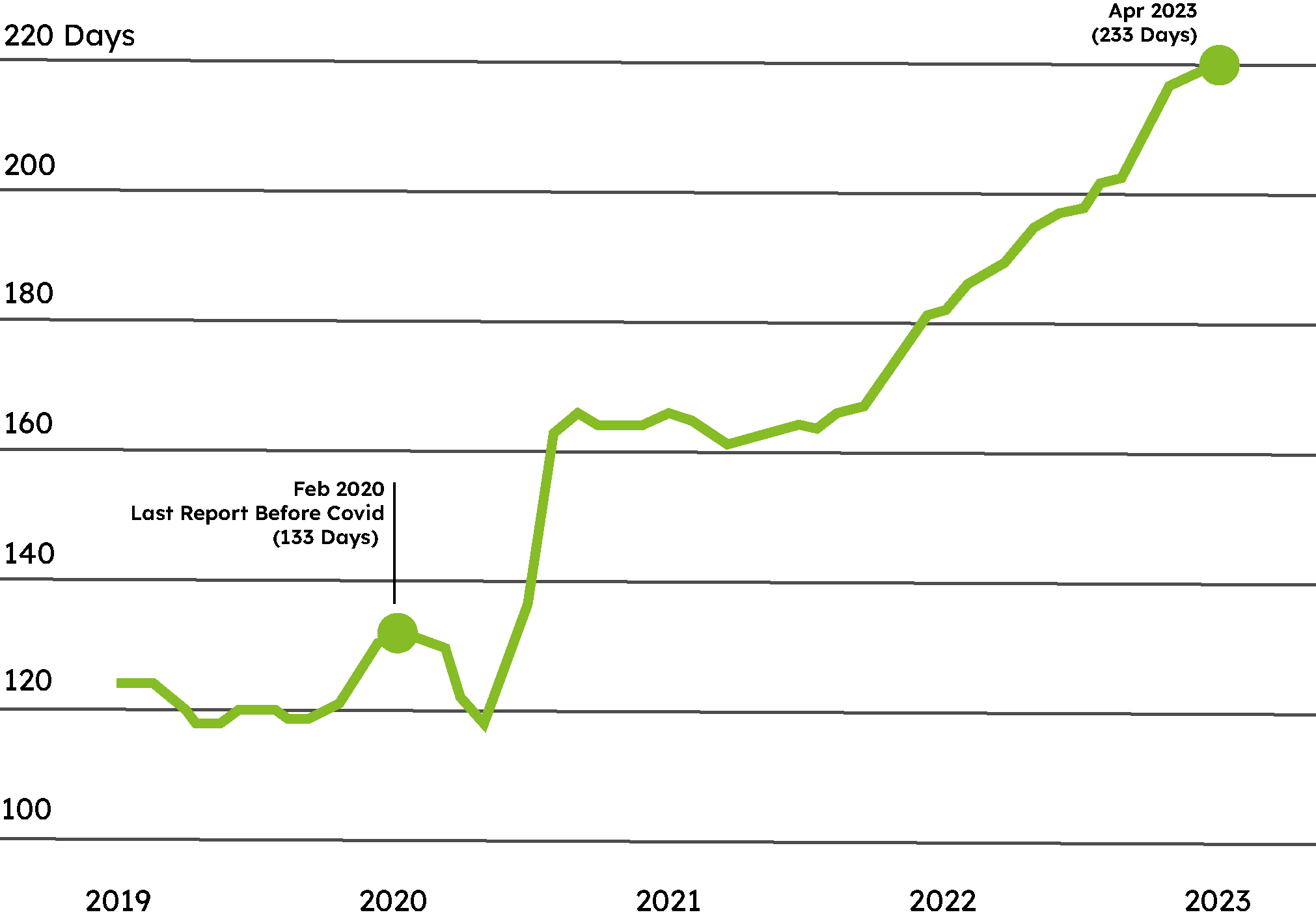
The wait time for an initial decision has increased 83% since 2020
Primary Research
4
Long Interviews
8
Short Interviews
3
Co Creative Workshops
Complex System & Process
The Problem: The intake process is inherently intricate due to strict eligibility criteria, extensive medical documentation requirements, and dense federal compliance regulations that confuse applicants.
The Design Vector: Provide clear, linear directions that translate a complex regulatory framework into an intuitive, step-by-step guided workflow.
Lack of Awareness & Communication
The Problem: Claimants face widespread misinformation and lack awareness regarding the core operational distinctions between overlapping programs, specifically SSI and SSDI.
The Design Vector: Enhance user understanding by surfacing transparent, plain-language guardrails upfront to help users immediately identify the appropriate benefit track.
Lack of Resources
The Problem: High-trust external stakeholders—such as healthcare professionals and doctors—lack the specialized training and definitive criteria needed to guide individuals seeking support.
The Design Vector: Provide necessary information and clear resource materials to equip assisting professionals to facilitate the application path effectively.
Lack of Accessible Information
The Problem: Essential administrative resources are deeply buried within confusing website layouts, relying on complex language that induces acute user stress.
The Design Vector: Improve discoverability by restructuring the information architecture, making critical entry points clear, legible, and easy to find.
The Problem
How might we relieve the pressure placed on the SSA and make the process simpler for the applicants
3
Cross-Disciplinary Workshops
9
Stakeholders
1-1.5
Hour Qualitative Inquiries
Doctors
The Reality: High-trust touchpoints operating under severe time constraints that prevent deep administrative training.
UX Requirement: Lightweight, scannable resource kits for immediate patient handoff without clinical overhead.
Librarians and Social Workers
The Reality: Front-line facilitators providing workspace and internet access, but legally restricted from giving medical or legal advice.
UX Requirement: Guardrailed workflows that allow proxies to safely guide users without crossing regulatory boundaries.
Applicants
The Reality: Operating under acute cognitive stress, struggling with basic navigation and SSI vs. SSDI program classification.
UX Requirement: Plain-language introductory frameworks deployed exclusively through highly trusted channels.
Ideation

While digital concepts scored high on technical feasibility, user testing revealed that true adoption depended entirely on institutional trust. To balance desirability, feasibility, and viability, we filtered out standalone, high-friction ideas in favor of a trusted, community-centered delivery model.

Service Blueprint: The Omnichannel Information Ecosystem

This ecosystem map outlines the omnichannel strategy ensuring claimants receive consistent information. It routes specialized resource kits to professional stakeholders (left) and public awareness kits to trusted community hubs (right), creating multiple accessible entry points for applicants.
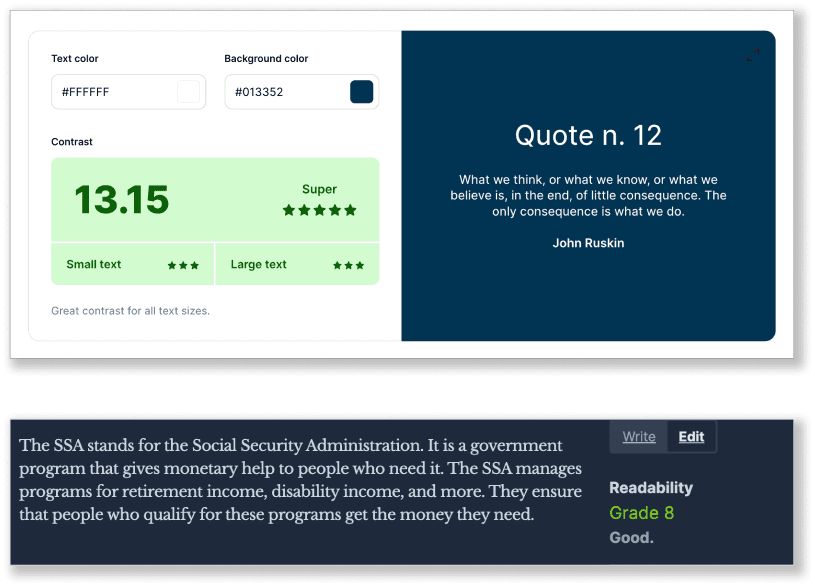
Accessibility

Final Designs
Website
Posters
Booklets
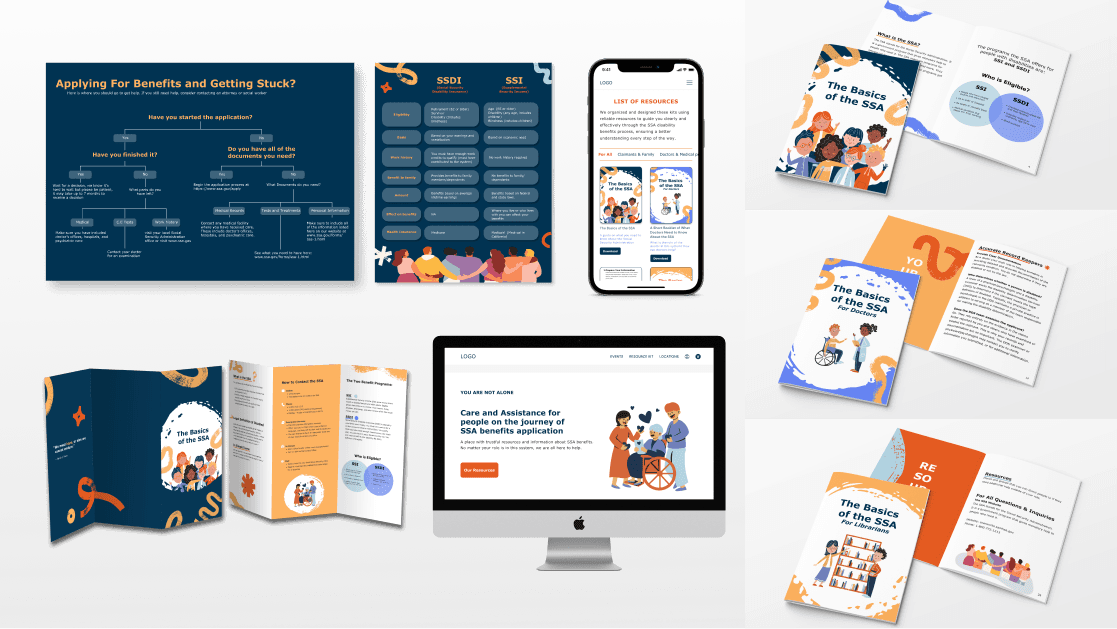
Website & App
The public-facing web and mobile platform bridges the gap between complex federal policy and diverse end-user constraints. Rather than hosting static information, the hub operates as an active self-service ecosystem designed to minimize processing errors and lower applicant cognitive load.

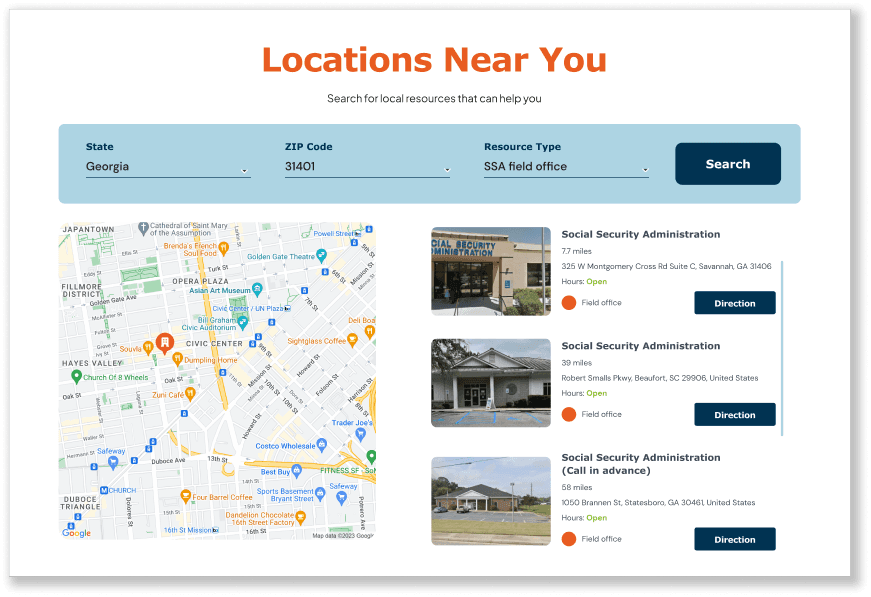
Locations Near You
Pain Point: Frequent SSA office closures and operational shifts leave traditional directories completely outdated, causing users to waste critical time trying to find open, verified physical locations.
Solution: A location-aware map that centralizes real-time agency updates and trusted community hubs into a single, instantly reliable searchable directory for in-person processing.
Document Wizard
Pain Point: Application pipelines are backlogged due to high rates of incomplete paperwork, caused by users struggling to decipher dense regulatory criteria.
Solution: A conversational screening wizard using progressive disclosure to break down regulatory matrixes into bite-sized steps, generating a personalized, plain-language document checklist before intake begins.

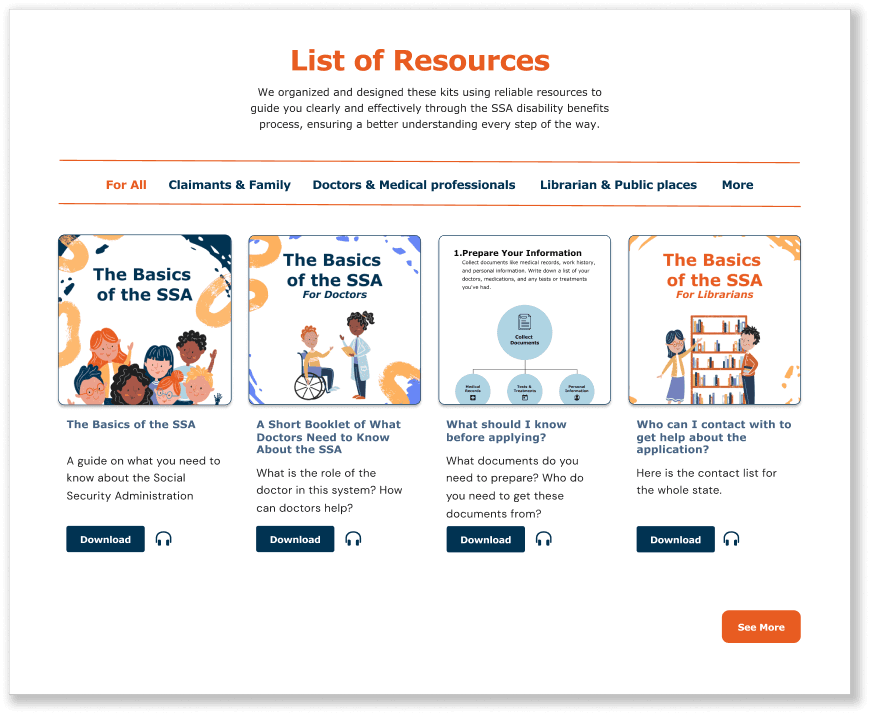
List of Resources
Pain Point: Crucial programmatic materials rely on dense legal jargon and are buried in complex website hierarchies, creating massive literacy and accessibility barriers.
Solution: A role-segmented directory filtering asset kits by user type (Claimants, Doctors, Librarians) to maintain legal compliance boundaries, featuring embedded WCAG-aligned text-to-speech tools.
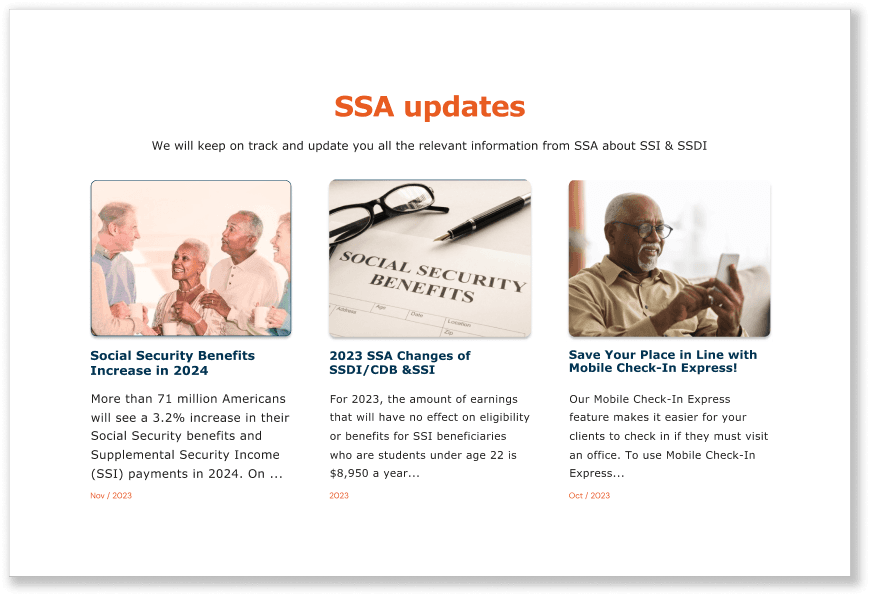
SSA Updates
Pain Point: Widespread misinformation and reliance on outdated rumors regarding shifting benefits criteria trigger critical applicant data-entry errors.
Solution: A real-time administrative timeline feed presenting official policy adjustments and program updates in a highly legible, scannable news card layout.
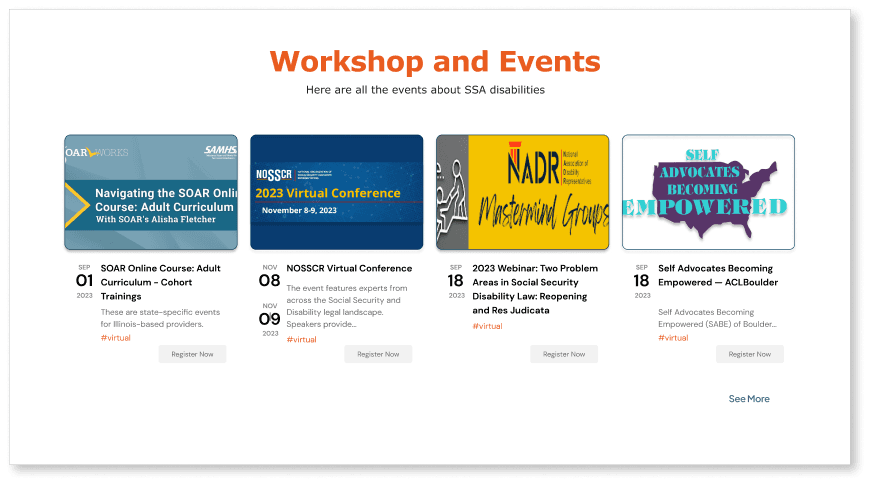
Workshops and Events
Pain Point: Vulnerable applicants frequently navigate a long, exhausting application journey in isolation, lacking direct access to peer support or hands-on guidance.
Solution: An integrated local event manager surfacing nearby mutual aid workshops, educational webinars, and training sessions to bridge digital users with physical community networks.
Booklets
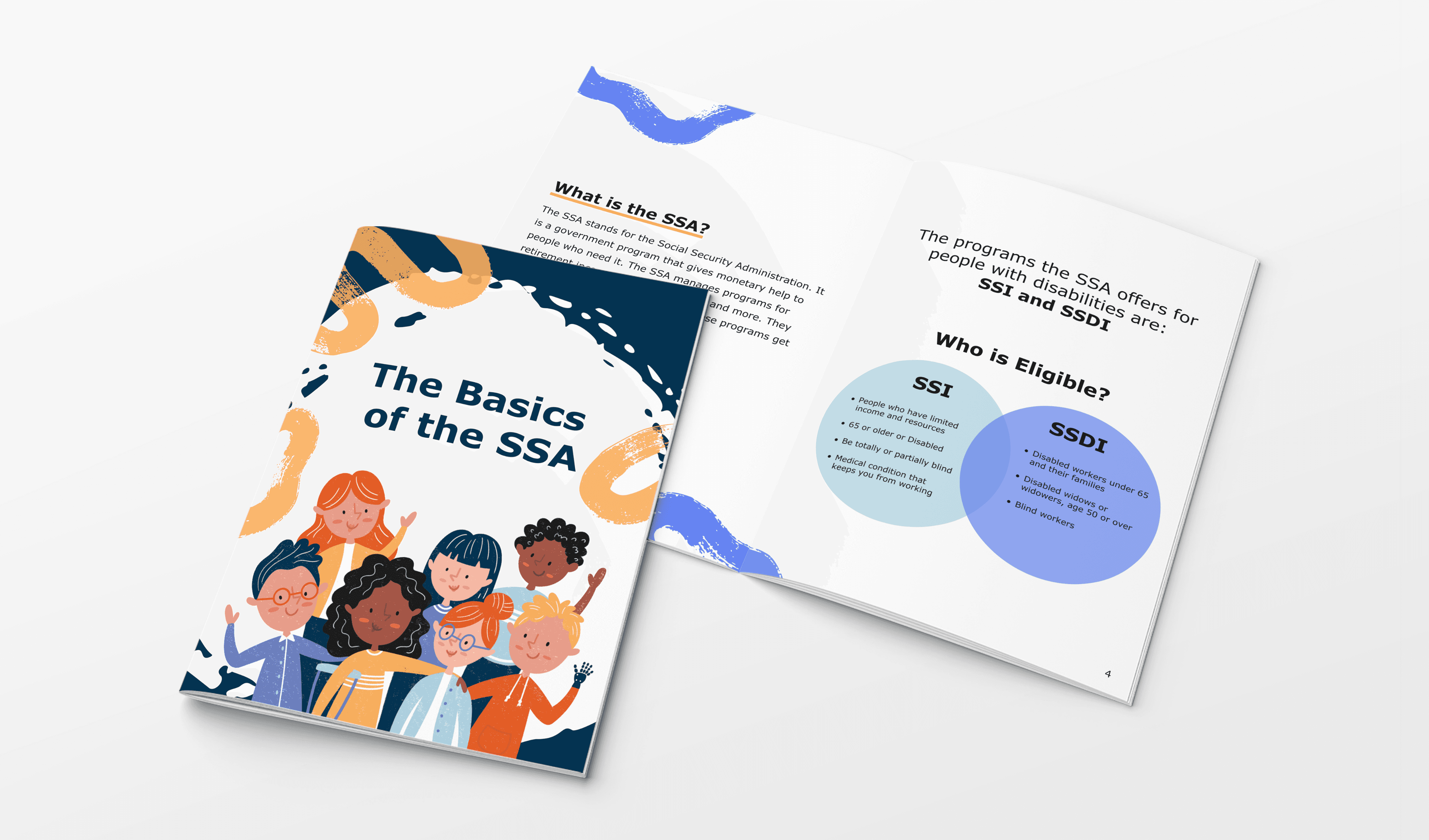
For Claimants
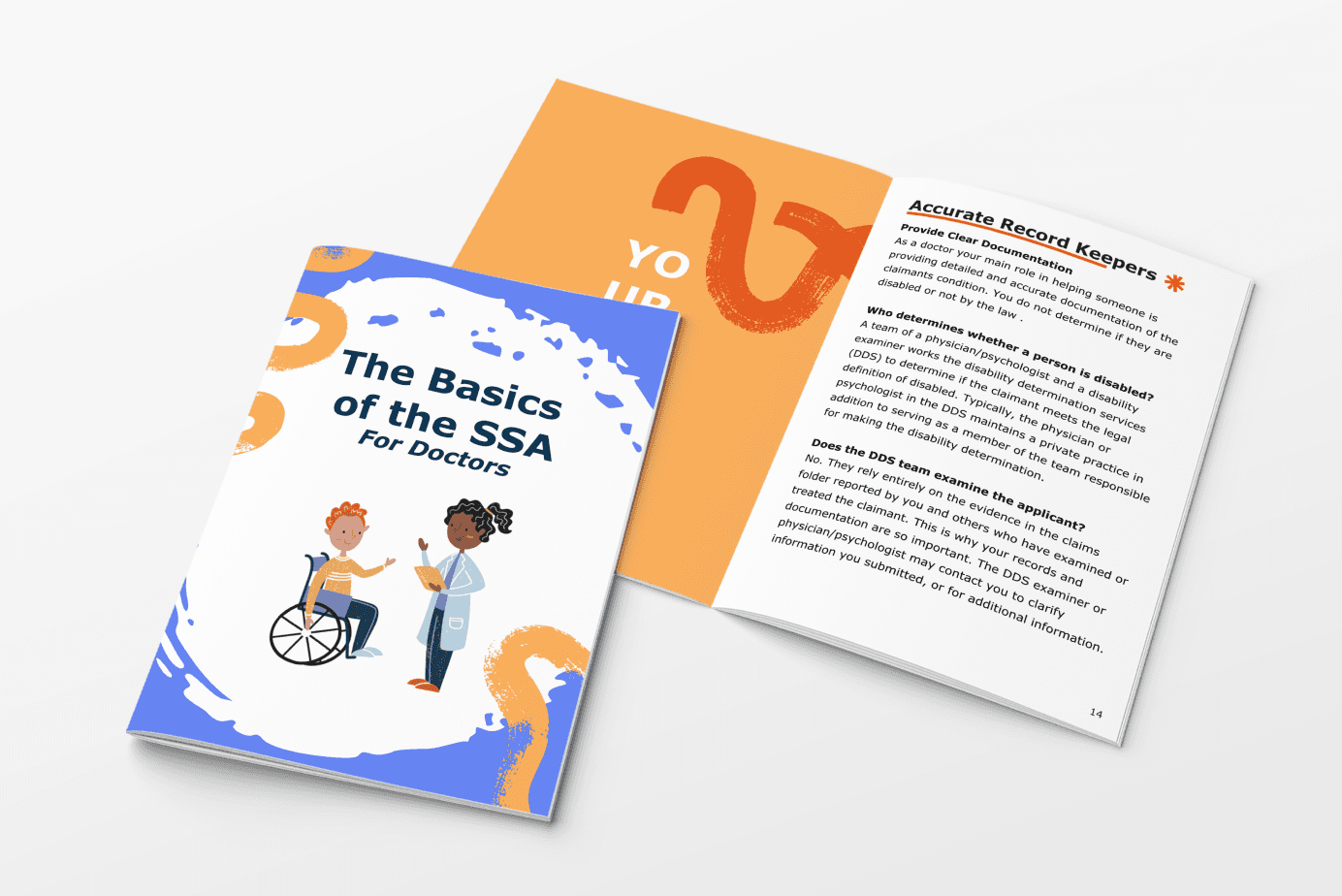
For Doctors
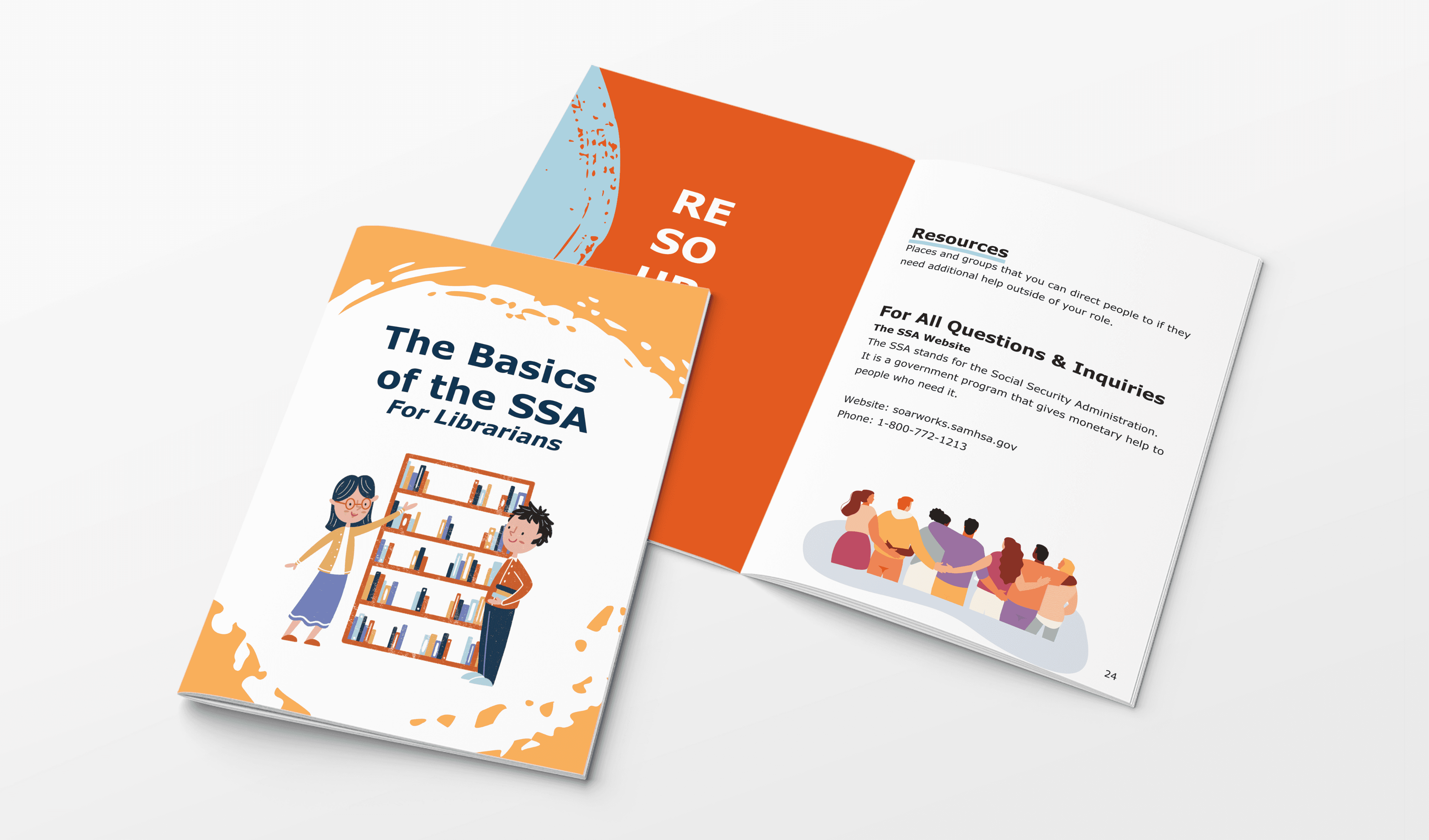
For Librarians
Core Definitions
Pain Point: Applicants frequently struggle to distinguish between highly overlapping federal programs (SSI vs. SSDI, Medicare vs. Medicaid), leading to incorrect applications and immediate programmatic rejections.
Solution: A comparative layout that translates complex statutory terminology into clear, side-by-side matrices, allowing users to quickly self-verify their correct application track.

The Process - For Claimants
Pain Point: Navigating the complex, multi-step application sequence can be intimidating, leaving claimants uncertain about the exact workflow and what to expect after submission.
Solution: A visually guided step-by-step roadmap that breaks down the application stages into clear actions and explicitly outlines post-submission expectations to reduce user stress.

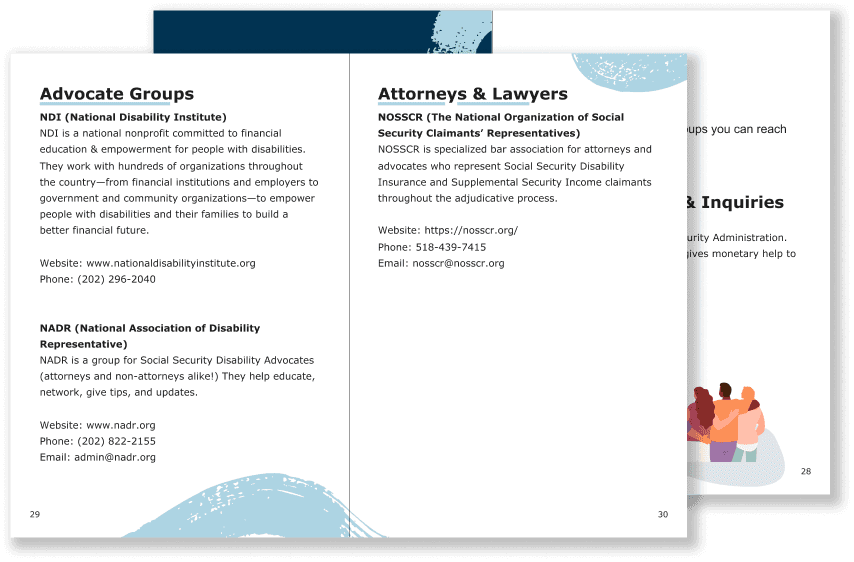
Resources
Pain Point: Claimants frequently struggle to isolate the official digital source of truth or locate trusted advocacy organizations capable of providing legitimate, specialized assistance.
Solution: A dedicated resource directory that explicitly positions the official SSA website as the primary source for all information, supplemented by trusted external support networks like the National Disability Institute.
Community Ally Enablement
Pain Point: Frontline community proxies—like librarians and healthcare professionals—want to support applicants but lack clear operational boundaries and structured reference materials to guide them safely.
Solution: A specialized role-based layout that clarifies institutional boundaries and equips trusted local allies with the exact criteria needed to act as decentralized support channels.

Pamphlet
Pain Point: Widespread misconceptions regarding eligibility parameters deter qualified individuals from initiating the benefit process entirely due to initial confusion.
Solution: An approachable, highly scannable tri-fold pamphlet that synthesizes basic criteria and establishes a clear, low-friction entry point that points users directly toward deeper resources.

Posters
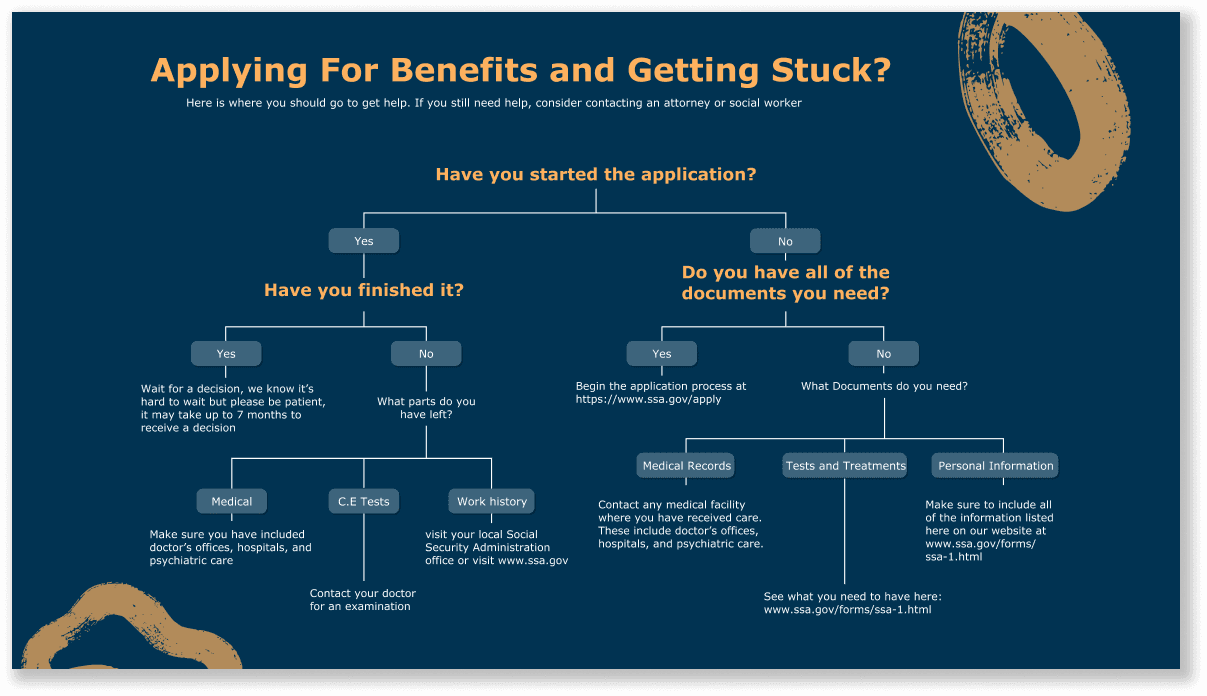
Diagnostic Navigation Flowcharts
Pain Point: A significant percentage of benefit claims are rejected simply because applicants submit the wrong corroborating evidence for their specific medical conditions.
Solution: Publicly deployed logic flowcharts that utilize interactive decision trees, allowing users to trace their unique situation and instantly isolate the exact medical documentation required for submission.