

Duration
2026 - present
Location
New York, USA
My Responsibilities
User Research
Primary Research
Product Discovery
Ideation & Iteration
Wire-framing
Prototyping
Usability Testing
Tools
Figma
Jira
Blueprint
New York State's Office of Temporary and Disability Assistance (OTDA) oversees programs that provide essential financial, nutritional, and housing support to low-income individuals and families.
They also provide an appeal process where individuals can challenge a local agency’s decision to deny, reduce, or stop their benefits.


Context
150,000+
Fair Hearing cases per year.
4,000,000+
New Yorkers rely on state or federally funded government support.
10,000+
Cases backlogged at any given time.
85.8%
People affected by the delays were legally eligible for the benefits they were denied.
Research
1,000+
Hours of User Interviews
5+
Journey Mapping sessions
20+
Iterations
Complex and Confusing Paperwork
Applicants often struggled with accurately completing lengthy, technical legal forms. A single blank field or illegible handwriting on a paper form can result in your request being rejected or delayed
Lack of Real-Time Updates
Claimants cannot log into a digital portal to check the exact status of their case. Tracking an appeal requires calling OTDA phone lines (1-800-342-3334), which often suffer from long hold times, making it difficult to confirm if a hearing was successfully scheduled or an adjournment was processed.
Extreme Backlogs and Delays
The system has struggled with massive backlogs. Plaintiffs in lawsuits have reported waiting months—or even years—for decisions on crucial programs like SNAP (food stamps) or Temporary Assistance. These unacceptable wait times force eligible New Yorkers to rely on family or choose between paying rent and buying food while they wait for their cases to be resolved
Physical Submission Hurdles
Many applicants must wait for a physical form to be mailed to them or locate and download a printable PDF form themselves, which is a barrier for those without access to printers or the internet.
Mailing a paper form to the state can result in significant processing lag compared to electronic requests. This delay is particularly dangerous for "Aid Continuing" requests, which must be submitted within 10 days of your notice to prevent benefit cuts during the appeal.
How might we modernize the Fair Hearings process to make it easier for the users to apply, receive and maintain their benefits.
Final Design
Dashboard
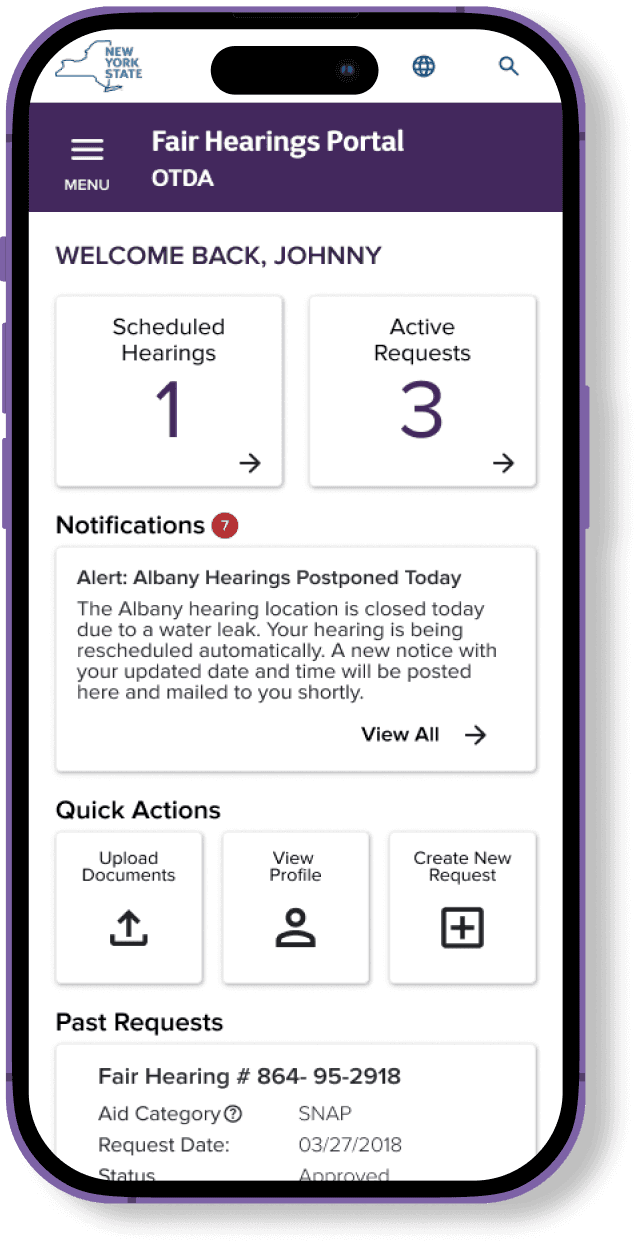
The dashboard offers users a centralized, high-level overview of their active fair hearing cases. Key metrics—including upcoming hearings, active requests, urgent notifications, and historical case activity—are surfaced immediately to reduce cognitive overload for users navigating a complex legal system.
Recognizing that many applicants may feel overwhelmed or uncertain of their next steps, the UI incorporates a dedicated Quick Actions bar. This features high-priority tasks like uploading documents, updating profiles, or initiating a new request, ensuring essential functions are always intuitive and accessible.
Application Form
The fair hearings application is a complex legal process that can easily overwhelm applicants. To mitigate this, the intake form is broken down into smaller, digestible steps with contextual helper text embedded throughout to ensure clarity and drastically reduce submission errors.
To streamline data entry, users can input their notice number to automatically pre-populate the majority of the required information. Additionally, the form utilizes a section-based approach. This prevents cognitive fatigue and provides users with the flexibility to navigate only through the specific components that apply to their unique situation.


Get Help
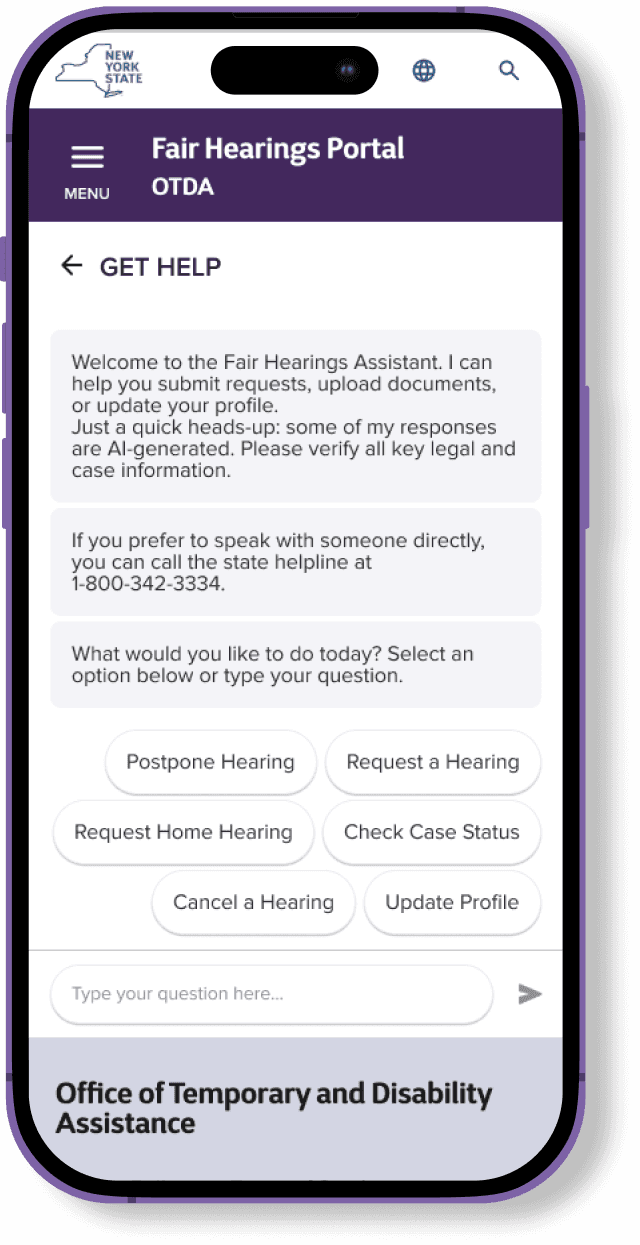
To ensure seamless platform navigation and reduce cognitive friction, users can interact directly with an intuitive chatbot tailored to handle procedural questions and guide them through their application. For more complex inquiries or personalized support, the interface provides an immediate human off-ramp by prominently featuring the official state helpline number, creating a balanced, omni-channel support experience.
Attend Hearings
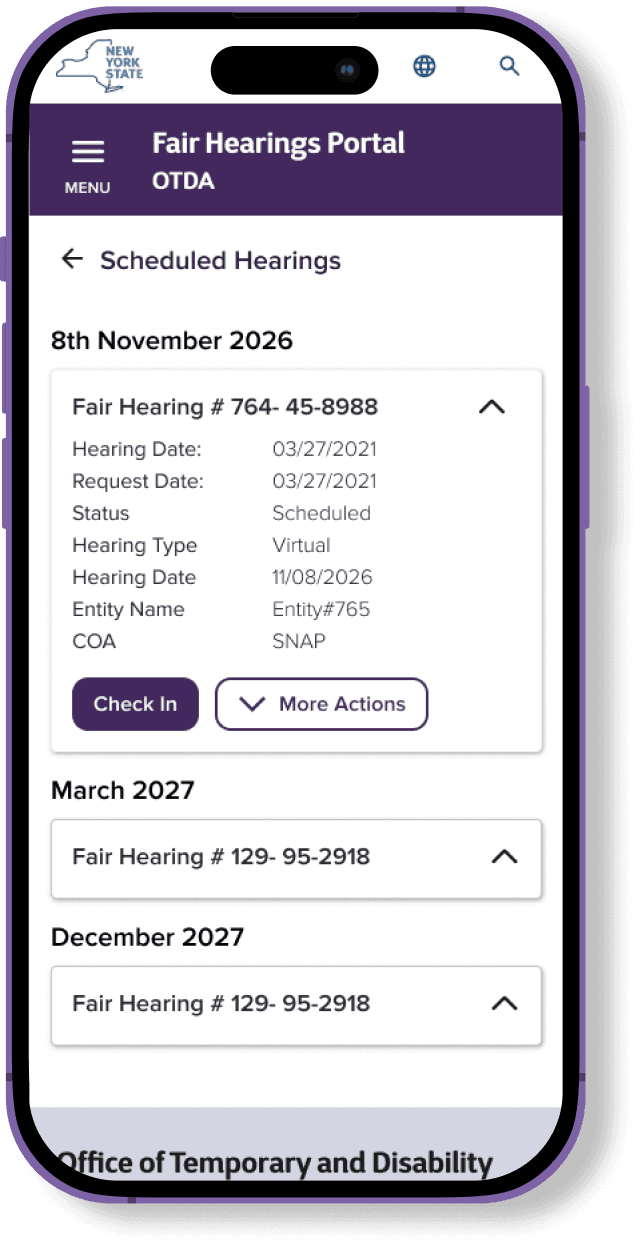
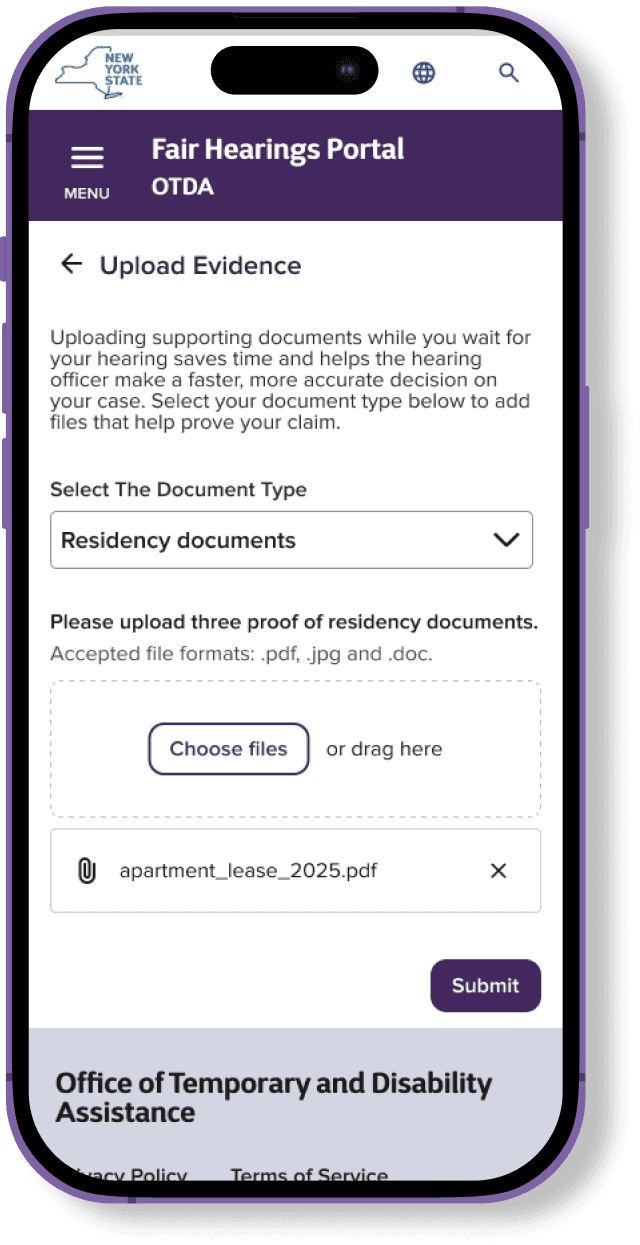
To eliminate the logistical burden of traveling to a physical office and waiting indefinitely, this feature allows users to attend their hearings remotely. Once the user (the "appellant") checks into the digital hearing lobby, real-time status tracking keeps them transparently informed of their representative's and the judge's availability. Furthermore, integrated document management allows appellants to upload supporting evidence directly within the lobby, saving crucial time during the official proceedings.

Results
21,000+
Successful enrollments
7 mins
Average completion time
86%
Reduction in enrollment errors vs paper form
Learnings
Thriving in Ambiguity & Building Structure
When I joined the Fair Hearings team, there was no established design process or centralized guideline system. Facing high-pressure delivery timelines, I balanced immediate deliverables while simultaneously building the foundational UX infrastructure. By developing a comprehensive set of design guidelines and introducing a structured UX workflow, I transformed a chaotic environment into a repeatable, scalable process that aligned the team and accelerated shipping times.
Designing Within Rigid Regulatory Frameworks
IThe Fair Hearings system is governed by strict, unyielding legal and business mandates that could not be altered, even when they created inherent user friction. Rather than pushing against immutable constraints, I learned to treat legal parameters as hard design boundaries. My role became one of translation: breaking down dense, over-engineered requirements into a clean information hierarchy. By restructuring complex legal steps into intuitive, digestible user paths, I successfully protected the user experience without compromising regulatory compliance.
Accelerated Time-to-Value
Stepping into the complex administrative appeals space with zero ramp-up time required a strategic approach to prioritization. Faced with immediate deadlines, I focused intently on solving the immediate user problem at hand while continuously mapping out the broader system logic in parallel. As a result of this high agility, I delivered production-ready designs by my fourth day that went straight into development, proving I could ship high-impact work while simultaneously mastering a dense domain.