
Role
Lead Product Designer
Duration
6 Months
My Responsibilities
User Research
Primary Research
Product Discovery
Ideation & Iteration
Wire-framing
Prototyping
Usability Testing
Tools
Figma
Jira
Blueprint
Location
New York, USA
NDA disclaimer:
This project is subject to a Non-Disclosure Agreement. To protect proprietary data, the client's identity has been entirely omitted, and all user flows, metrics, and features have been generalized using solely publicly accessible information.
The Clients:
A high-scale enterprise managing critical user cases faced severe operational bottlenecks due to an outdated, paper-reliant ecosystem. Processing over 150,000 applications annually, the lack of a centralized digital infrastructure led to a 10,000-case backlog, high administrative support overhead, and severe friction for users attempting to submit and track their cases.
Context
150,000+
Dispute arbitrations processed annually.
4,000,000+
End-users relying on the system ecosystem for essential benefits.
10,000+
Cases backlogged at any given time.
85.8%
Users affected by the delays.
Research
100+
Hours of User Interviews
5+
Cross-Functional Stakeholder Workshops
20+
Legacy System & Workflow Audits
High-Friction Data Intake
Users were forced to navigate dense compliance terminology and multi-page manual forms. This massive cognitive load directly caused high error rates, incomplete submissions, and severe data-entry friction.
Opaque Tracking & Information Asymmetry
A total lack of system transparency left users entirely in the dark post-submission. Without real-time tracking or status notifications, customer support channels were constantly overwhelmed by users seeking basic updates.
Operational Pipeline Bottlenecks
Legacy administrative processing speeds couldn't keep pace with incoming application volumes. Without automated prioritization or digital queue management, the system suffered massive case backlogs.
Fragmented Document Provisioning
Submitting critical supporting evidence required disjointed physical or digital channels. The absence of a centralized, secure upload mechanism led to lost documentation and broken verification loops.
How might we design a case management platform that simplifies filing disputes and provides clear status tracking for users?
Final Design
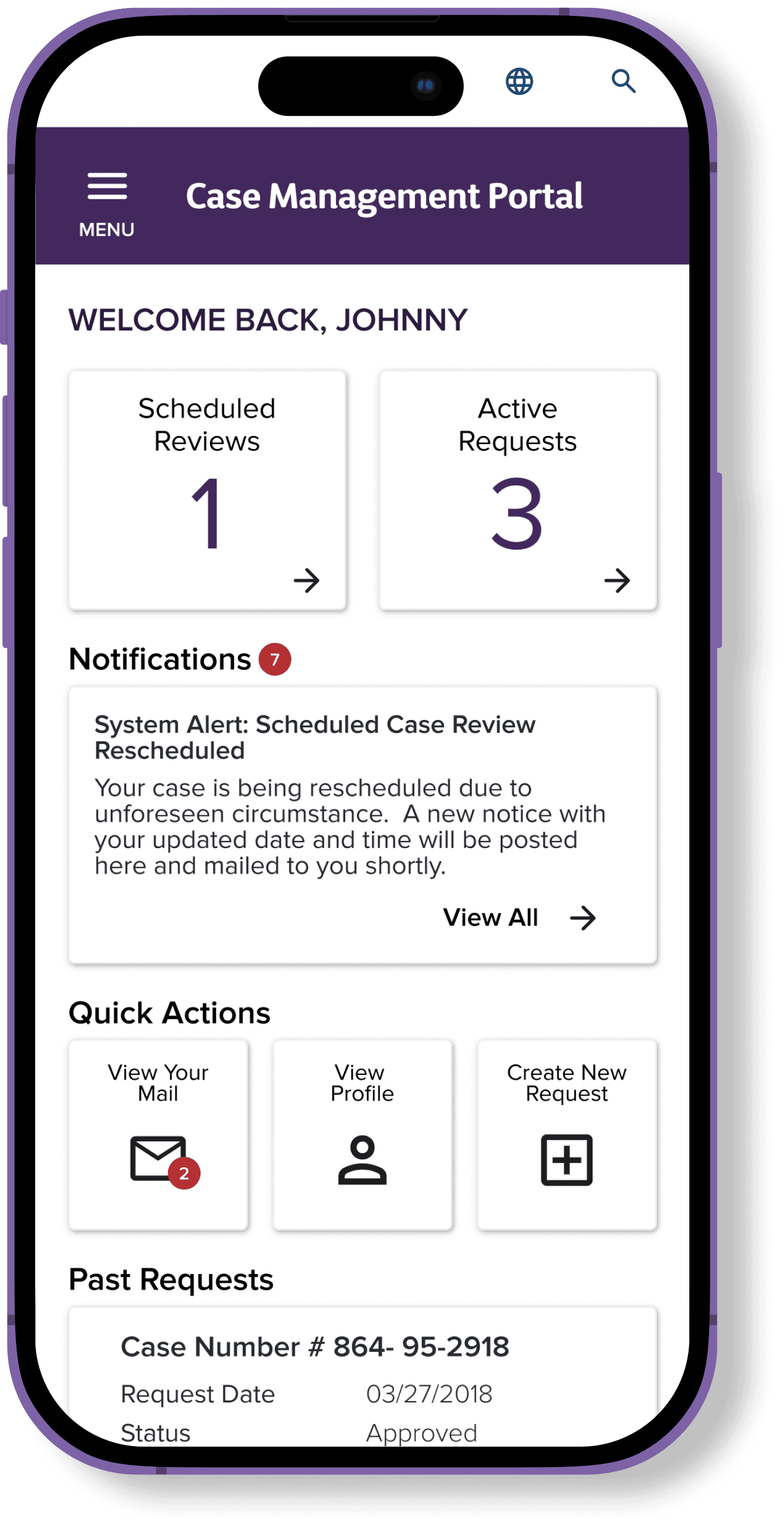
The Dashboard Hub
A centralized, high-contrast command center for users to track active dispute statuses in real time.
The Goal: Reduce administrative inquiries by offering clear visibility into case progression, document approvals, and upcoming review dates.
System Logic: Implemented a "Quick Actions" framework directly on the primary landing screen, allowing users to upload missing evidence or request case modifications in two taps without digging through deep navigation trees.
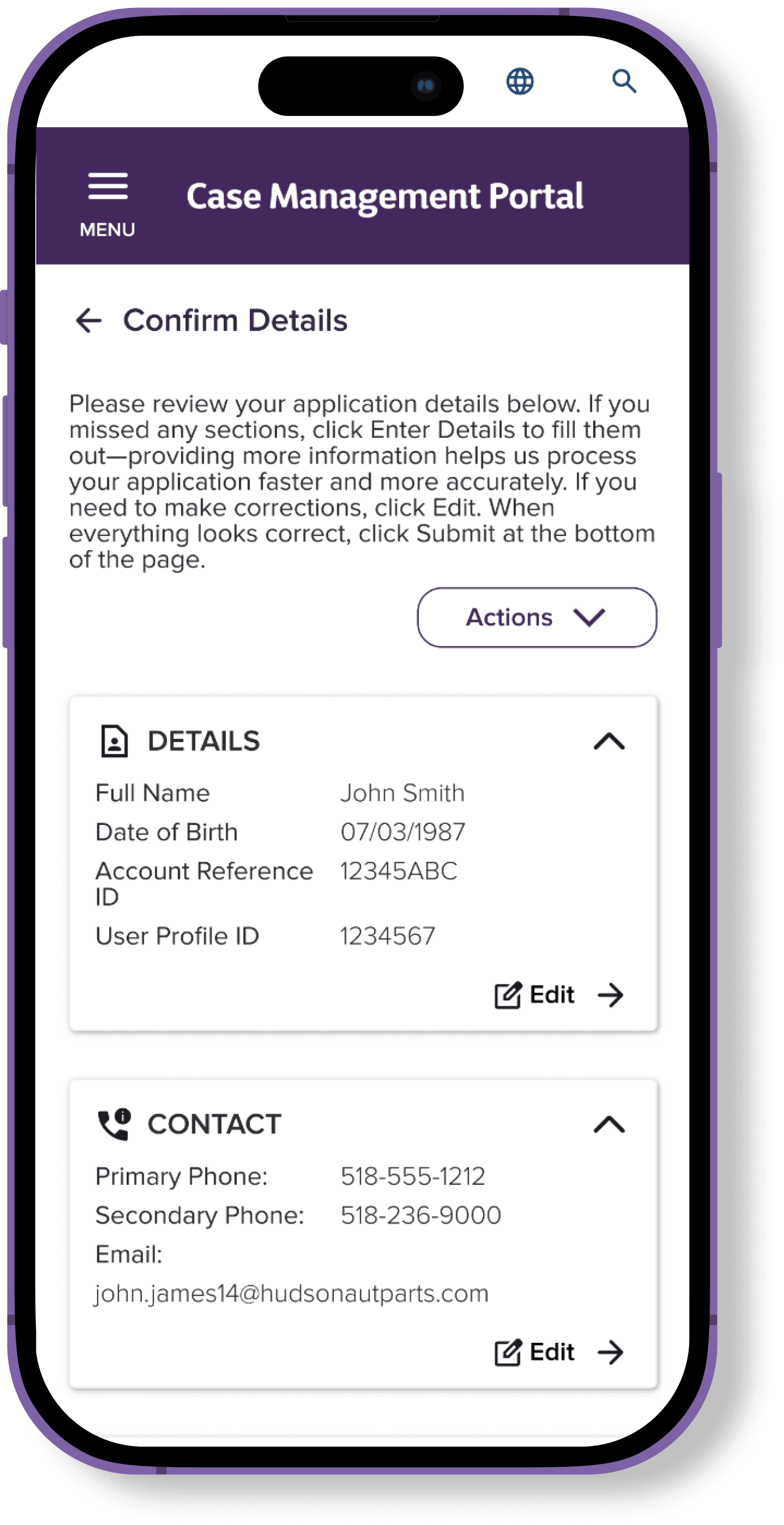
Progressive Intake Form
Transforms a complex compliance workflow into a frictionless, accessible digital experience.
The Goal: Lower the cognitive load of data submissions and dramatically decrease application drop-off rates.
Smart Autofill: Introduced a Notice Number lookup feature at the start of the flow. Entering a single reference ID queries the backend database to auto-populate personal and case metadata—eliminating manual data entry friction and reducing form abandonment.
System Logic: Structured inputs into a staged progressive disclosure flow with real-time data validation, preventing human error before the case hits the review queue.



Integrated Assistance Framework
Combines automated guidance with direct human support to ensure seamless platform navigation and eliminate cognitive friction.
The Goal: Provide immediate clarity on complex platform procedures while preventing users from getting stuck or abandoning mid-process.
System Logic (The Chatbot): Features an intuitive chatbot engineered to resolve standard procedural questions and guide users step-by-step through the workflow.
The Human Off-Ramp: For complex, high-stress, or personalized inquiries, the interface prominently surfaces a dedicated platform support line, ensuring a seamless pivot to direct human help when automation isn't enough.
Virtual Case Rooms
A secure, end-to-end digital environment for arbitrators, legal representatives, and users to conduct official dispute reviews completely remotely.
The Goal: Eliminate physical transit barriers and reduce the massive 10,000+ case backlog stalling the platform ecosystem.
System Logic: Designed a structured "Virtual Waiting Lobby" prioritizing clarity and system compliance. Included visible transparency disclaimers and live audio/video configuration checks so non-technical users feel confident before their formal session goes live.


Results
22,000+
Successful enrollments.
7 mins
Average completion time.
86%
Reduction in enrollment errors.
Learnings
Thriving in Ambiguity & Pace
Complex multi-portal projects inherently involve moving targets, shifting timelines, and incomplete data. Instead of letting ambiguity stall progress, I learned to use rapid, iterative prototyping as a tool to drive clarity. Moving quickly allowed us to validate concepts early, align cross-functional stakeholders on a concrete direction, and maintain a fast delivery pace even when the full technical architecture was still being defined.
Designing With Strict Guardrails
Operating within a highly regulated public-sector environment taught me to view strict legal policies and compliance mandates not as creative roadblocks, but as fixed design constraints. I learned how to successfully advocate for user-centered design patterns while strictly respecting institutional policy rules.
Cross-Functional Negotiation
I learned that the best user experiences are built on strong relationships with engineering. By bringing developers into the design process early to discuss database limitations and API constraints, we were able to negotiate the technical logic for the notice number lookup without compromising the core user experience or slowing down production timelines.